

(original post 1 Oct 2019)
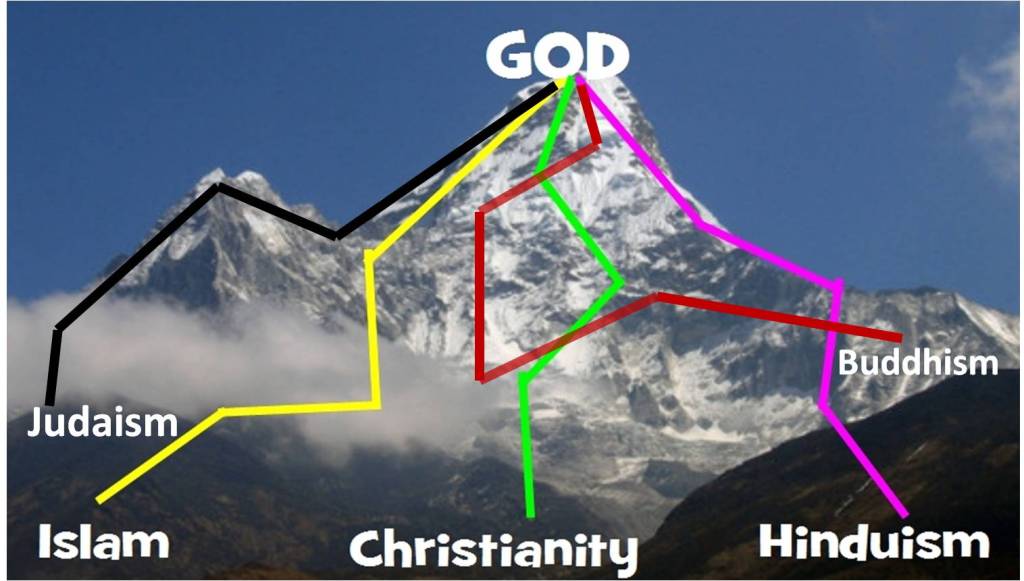
Controversial statement upfront—a person who claims “all roads lead to heaven” or “all religions are basically the same” exposes their ignorance towards the different religious worldview OR that they are a liar! Plain and simple, they don’t know what they are talking about OR they know somethings and are being deceptive. A cursory examination of Christianity, Islam, Hinduism, Buddhism, Mormonism, etc, looking at their fundamental doctrines, will make it plainly obvious that these ideologies DO NOT teach the same things NOR do they arrive at the same end! So, the answer to the question is a resounding “NO!”
Entire books have been written about each of the major worldviews and many have done the work of comparing and contrasting them with each other. A wonderful resource to this end is Contradict: They Can’t All Be True by Andy Wrasman (which I will draw upon in the following paragraphs as I list the foundational elements of major world religions). I will summarize and contrast four religious worldviews (there are many more, but the focus is to show that these teach explicitly different doctrines and are not alternative paths up the same mountain. As Ravi Zacharias puts it, “My premise is that the popular aphorism that ‘all religions are fundamentally the same and only superficially different’ simply is not true. It is more correct to say that all religions are, at best, superficially similar but fundamentally different.[1]”
Of first importance in this journey is the establishment of “truth.” Does objective truth exist OR is truth subjective? If you are bent towards subjectivity, this post will be like water on a duck’s back unless you are open-minded and searching for truth in life. Yes, objective truth does exist. Logic wouldn’t be possible without this cornerstone of reality. Mathematics and science wouldn’t be possible without truth. Society and culture would breakdown (and would never have been established) without the existence of objective truth. Before moving on, some terms need to be defined:
Truth—the body of real things, events, and facts: a transcendent fundamental or spiritual reality[2]
Objective—expressing or dealing with facts or conditions as perceived without distortion by personal feelings, prejudices, or interpretations[3]
Subjective—peculiar to a particular individual: modified or affected by personal views, experience, or background; arising out of or identified by means of one’s perception of one’s own states and processes; lacking in reality or substance[4]
In layman’s terms, objective truth is how reality is without personal input, just a record of facts without regard to an individual’s feelings. Subjective truth is individualistic and may vary from person to person while having little to no grounding in reality. For example: the human race is a binary sexual species consisting of males and females. Natural reproduction is done through this male-female process. Denying that males and females exist is a subjective viewpoint; objective reality is that males and females exist—contrary viewpoints are psychological in nature (that is they stem from an individuals thoughts and emotions to come to a conclusion which, in essence, ignores the “facts” of reality).
Regarding religions, each religious worldview establishes exclusive “truth” claims which conflict with each other. The law of non-contradiction in logic states that, “something cannot be both true and not true at the same time when dealing with the same context.[5]” For example: if someone approaches my wife and I and says “I hear you’re expecting a baby.” If I say “no” and my wife says “yes,” there is confusion. Either she hasn’t told me, she’s pregnant, one or both of us misunderstood the statement, or some other situation. Regardless the case, both answers cannot be true. My wife cannot both be pregnant and not pregnant at the same time. Likewise, truth claims within differing religious worldviews cannot both be true; only one can be true OR they can all be false, but there cannot be a plurality of conflicting claims and all of them be true at the same time, in the same context.
Hinduism—pantheistic (all is one and one is god; divine essence in everything); reincarnation—after death, the soul / individual (atman) is reborn into a new life (does not have to be another human); karma guides reincarnation—karma is a “debt” which needs to be paid in order to break cycle of life-death-reincarnation; moksha—having paid all karmic debt, becoming free of karma & reincarnation, achieving oneness with Brahman—occurs after death; Vedas—religious texts for Hinduism; Brahman is the divine entity of which everything is a part of; an avatar is an incarnation of a Hindu deity; Krishna is most famous and worshipped Hindu deity.
Buddhism—non-theistic / atheistic (no god); branched off of Hinduism when Gautama Buddha rejected some of Hinduism’s teachings; dharma—Buddha’s teachings: includes—pain is a mark of reality, life is impermanent, humans have no souls; followers try to achieve nirvana (enlightenment)—ends the cycle of karma & reincarnation—achievable in life, not death; teaches anatman (no self, no individual); Four Nobel Truths: to live is to suffer, desire causes suffering, end desire—end suffering, this is achievable by following the 8-Fold Path; 8-fold path—right view, right intent, right speech, right action, right occupation, right effort, right thought, and right concentration.
Islam—Islam means “submission;” monotheistic—god (allah) is one being; line of prophets ending with Muhammad; Muhammad received the koran over the span of 22 years through visits by the archangel Gabriel; teaches 5 pillars of Islam to obtain paradise—creedal confession of faith (shahadah), prayer, charity, fasting during Ramadan, pilgrimage to Mecca; halal diet (similar to OT Hebrew diet restrictions—also includes ban on alcohol; Jinn—genies, adopted into Islam from Arabian culture; works-based system to obtain paradise by practicing 5 pillars, no certainty of eternal future; one life to live.
Christianity—Trinitarian monotheism (one God in 3 distinct persons—Father, Son, Holy Spirit); Bible (Old Testament and New Testament); man is separated from God by sin—God eliminates sin through atoning, substitutionary sacrifice of His Son (Jesus); individuals are eternal souls with physical bodies—after body dies, soul will exist eternally in Heaven or hell; eternal destiny dependent upon submission to Jesus as Lord and Savior (heaven—restoration to God) OR rejection of Jesus (hell—eternal separation from God); redemption through work of Jesus alone—man cannot do anything to save him/herself; one life to live.[6]
These summaries are rough overviews and in no way exhaustive, yet they lay the groundwork for contrasting their teachings.
Teachings & doctrines derived from—Vedas (Hinduism), dharma (Buddhism), Koran (Islam), Bible (Christianity)
Karma and reincarnation (Hinduism & Buddhism) vs one life followed by eternal fate (Islam & Christianity)
All is part of the divine (Hinduism) vs there is no god (Buddhism) vs monotheistic Allah (Islam) vs Trinitarian God (Christianity)
Individuals have a soul (Hinduism, Islam, & Christianity) vs there is no soul (Buddhism)
Eternal destiny: return to divine essence (Hinduism) vs nirvana (Buddhism) vs paradise / hell (Islam) vs heaven / hell (Christianity)
Do good to earn good karma (Hinduism) vs eliminate desires (Buddhism) vs follow 5 Pillars (Islam) vs Jesus’ death, burial, & resurrection to forgive sin (Christianity)
Some other differences in teachings:
Islam—Jesus didn’t die on the cross (Sura 4:156-159) vs Jesus died on the cross (Matt 27:32,35; Mark 15:24-25, Luke 23:33, John 19:23-25)
Islam—man created in paradise; Christianity—man created on earth
Islam—man created from blood clots and mud; Christianity—man created by dust and breath of God; woman from part of man’s side
Islam—Jesus is a prophet of allah; allah has no children; Christianity—Jesus is the Son of God; fullness of God in body of man
It should be obvious that these four religious worldviews have striking differences in their teachings. When we apply the law of non-contradiction to conflicting claims (soul vs no soul, nirvana vs heaven / hell, Jesus died on cross vs didn’t die on cross, etc) these contradicting claims cannot all be true at the same time. It’s either one OR the other! So, when a person says “all religions are the same / lead to God” they either don’t know what they’re talking about (ignorant) or lying! I invite you to do some research on this matter further; as mentioned above, a great resource to this end is the Contradict book by Andy Wrasman. At the end of the day, the objective is two-fold: 1) objective truths exist & 2) truth about reality and man’s eternal destiny can be known.
~In Christ!
[1] https://www.rzim.org/listen/just-a-thought/fundamentally-different-superficially-similar
[2] https://www.merriam-webster.com/dictionary/truth
[3] https://www.merriam-webster.com/dictionary/objective
[4] https://www.merriam-webster.com/dictionary/subjective
[5] https://carm.org/dictionary-law-of-non-contradiction
[6] Wrasman, Andy, Contradict: They Can’t All Be True, https://contradictmovement.org/
 Way Truth Life Apologetics
Leave a comment