

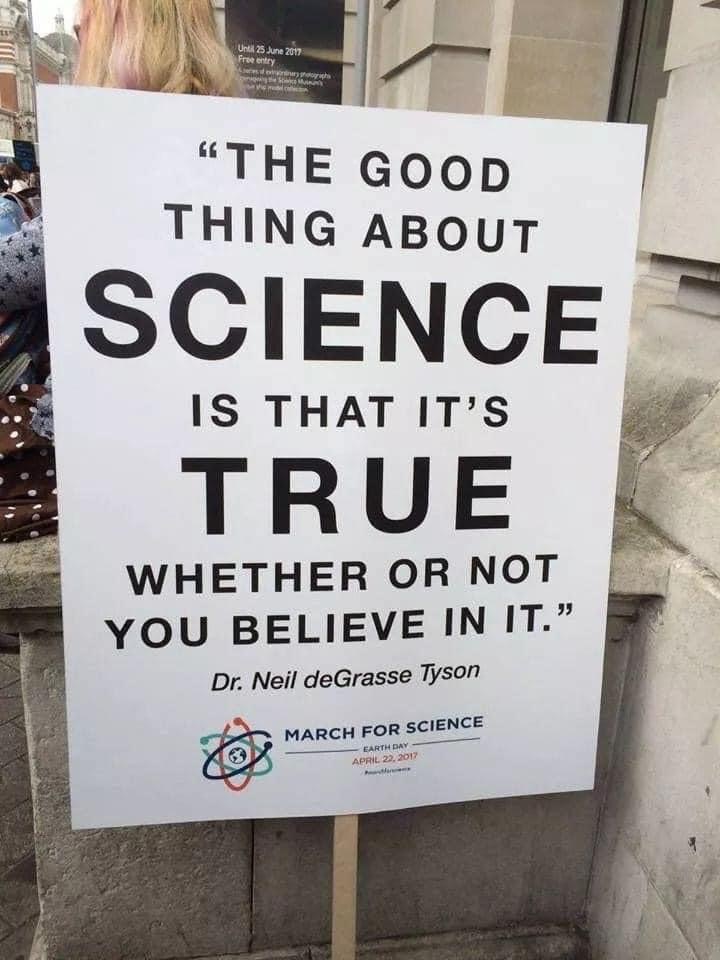
Today is going to focus on being able to spot, address, and substantiate one’s argument. Let me set the stage first. The picture posted above is what fueled this topic. Dr Tyson is a fairly well known and popular expert when it comes to science. A friend of mine from college shared this picture, and I recognized flawed thinking within the claim and addressed it. What follows is pushback from a complete stranger to me, but an acquaintance to my friend. This exchange took place a couple weeks ago, and I decided to tip my hat to Tim Barnett’s Red Pen Logic[1] approach to break down the retorts I received and highlight where some additional flawed thinking was applied.
Do you recognize the issue with the claim made by the quote? (Please take a moment to mull it over and see if you can figure out what the issue is before reading on)
Answer: The claim made is not a scientific claim, it is philosophical. There is no scientific experiment that can be run to determine the truthfulness / validity of the statement “science is true whether or not you believe in it.” The statement also claims that this is “good” which is a moral term and brings into view another issue, but that will not be addressed here today. My comment on my friend’s post was this:
“Science cannot determine the truthfulness of that claim; it is philosophical. Science is simply the gathering of data. Scientists ‘interpret’ that data and the interpretation is influenced by their worldviews & biases. Philosophy and logic are needed to draw conclusions and determine truth[2]”
Thus ensued the brief, contentious debate which I don’t engage in as often as I once did owing to how many people: 1) don’t understand the proper use of logic & reasoning, 2) are often entrenched in their ideas and unwilling to budge (myself included at times, I will admit), 3) not attempting to understand a person’s opposing view and instead seeking opportunity to appear superior in their own thinking and understanding, and 4) the quick breakdown where offenses are hurled at the other person (formally called ad hominem) which is a part of the exchange I will highlight below).
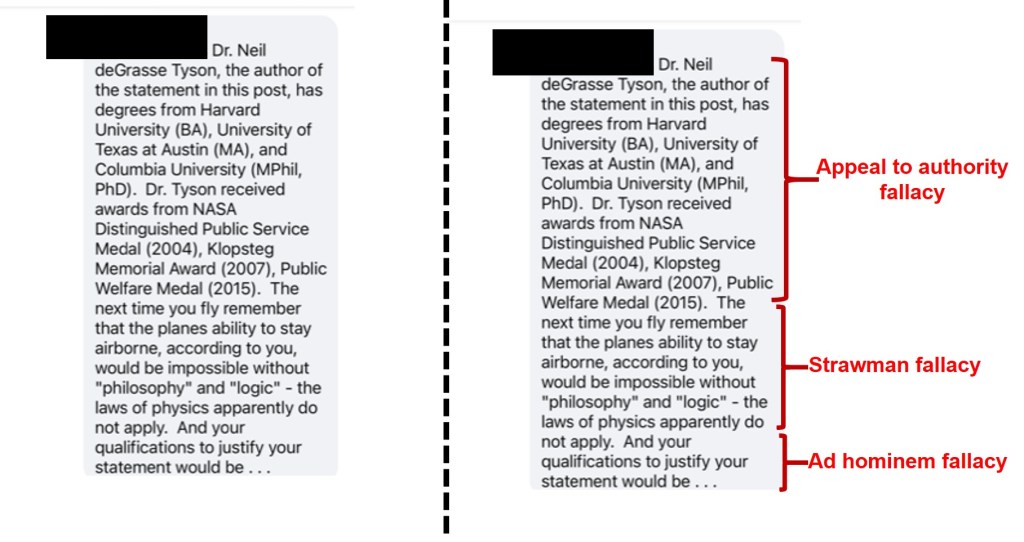
Here’s where I draw on Red Pen Logic in my approach to visually breaking down the issues in the responses (I initially identified three logical fallacies in play—there may be more but I will focus on the three I addressed in the online debate). First, you can see that a list of academic and professional accomplishments for Dr. Tyson was provided. This is an example of the “appeal to authority” fallacy[3]; I will pause to note that the claim Dr. Tyson has an MPhil (Masters of Philosophy) from Columbia University I only find mention on his Wikipedia[4] page. The website The Famous People[5] lists that he obtained a Doctorate in Philosophy in Astrophysics. However, Biography[6], Britannica[7], and other sites have no mention of this degree. Dr. Tyson may well have this degree, however he is not known for his work in philosophy. Rather, his expertise, writing, speaking engagements, and media interviews regard the area of astrophysics. A number of Christian apologists have made the same criticism as I have in books, articles, and on podcasts (and to that end I might be challenged for appealing to authority, too). Another note—people with a number of degrees are still capable of making illogical / nonsensical claims; there are many people with college degrees who demonstrate a lack of knowledge and wisdom. Richard Dawkins believes there is no God. John Lennox believes there is. Both of them have doctorate degrees and based on the Law of Non-Contradiction, one of them is wrong.
Second, a strawman fallacy[8] was used. A misrepresentation of my claim was used to make a false conclusion that “the planes (sic) ability to state airborne…would be impossible without ‘philosophy’ and ‘logic’ – the laws of physics apparently do not apply.” I do not see how one could reasonably come to such a conclusion. I said nothing of the sort and the responder never provides his reasoning / line of argumentation to apply my claim to his retort and its conclusion.
Third, he questioned what my “qualifications to justify” my critique. This is an ad hominem fallacy[9], attempting to invalidate my claim by implying that I am not in a position to make such a critique. What bearing does this have on the discussion? How does my academic history / achievements, experience, and accolades have any impact on one’s ability to offer criticism and correct perceived error? It has no impact whatsoever. This was merely an attempt to belittle me because I may not have the notoriety of Dr. Tyson.
My response to this counter was:
- Point out the above three fallacies,
- Provide a list of noted Christian apologists who have made similar challenges as I did,
- Address that an appeal to authority does not invalidate a claim because it’s not a reasonable refutation, and
- To illustrate the irrationality of comparing qualifications by asking “what are your credentials and qualifications to justify your retort of my statement”—adding that “it has no bearing on the issue”
In this one response to my claim, (at least) three logical fallacies were employed AND my claim was not refuted with reasoned evidence. That is the purpose of debate and discussion. When a person appears to make an erroneous statement / claim, if it is challenged, the challenger needs to provide evidence (reasonable and logical) why the claim is false and flawed. That didn’t happen here.
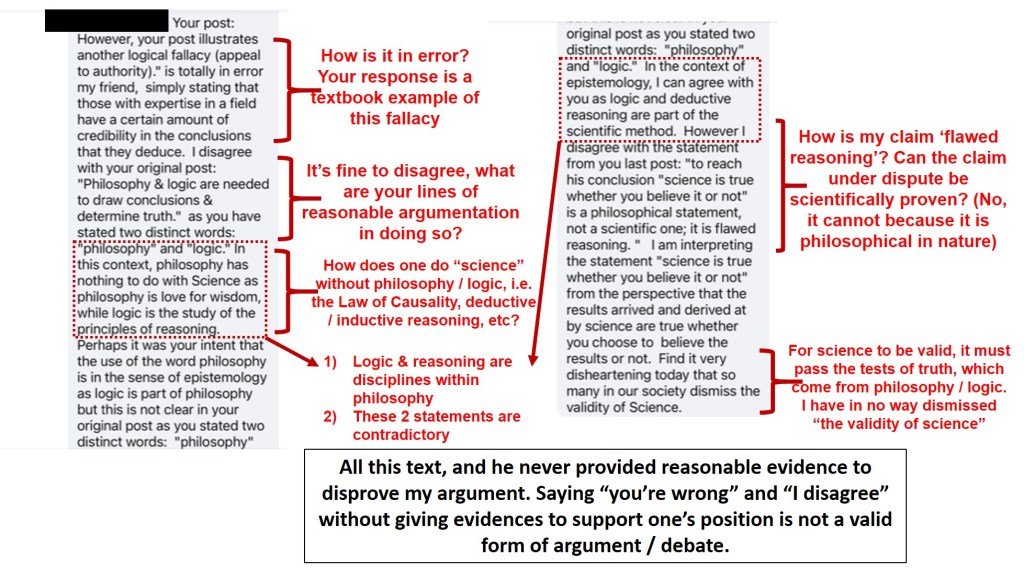
Instead, another response was given where the main pushbacks were “you’re wrong” and “I disagree”—again, no reason, line of argumentation, or evidence was provided to substantiate why I was “wrong” or rationalizing why he “disagreed” with my claim. Disagreement is fine and acceptable. As humans we are not all in agreement regarding most issues in life. If we were, tolerance would not be a thing. You do not tolerate those you agree with BECAUSE you are in agreement with them—there’s nothing to tolerate. You tolerate those you disagree with in order to find a sensible, civil way to live together within a society.
For all this albeit brief exchange, the debate went nowhere. I still feel validated in my position of critique against Dr. Tyson’s claim. The disagreeing commentor likely feels the same, however he provided nothing to substantiate his challenge to my claim. The conversation was not advancing and so I chose to not respond further. This exchange illustrates how important logic and reasoning are in conversation, especially when the discussion becomes a debate. Using flawed logic, employing logical fallacies, and simply stating “you’re wrong” and “I disagree” without supporting evidence does not win a debate, formal or informal. There is a breakdown in civil conversation and I pray that we, as a culture and society, are able to rediscover and apply that lost art.
~In Christ!
[2] Quote from me in the comment thread—thread not linked so as to not call anyone out by name; this is not intended to be a hit piece or to humiliate so the other party will be anonymous out of courtesy
[3] Appeal to Authority – Examples and Definition – Logical Fallacy (logical-fallacy.com)
[4] Neil deGrasse Tyson – Wikipedia
[5] Neil DeGrasse Tyson Biography – Childhood, Life Achievements & Timeline (thefamouspeople.com)
[6] Neil deGrasse Tyson – Books, Wife & Cosmos – Biography
[7] Neil deGrasse Tyson | Biography, Books, TV Shows, & Facts | Britannica
[8] Definition and Examples of the Straw Man Fallacy (thoughtco.com)
[9] Definition and Examples of an Ad Hominem Fallacy (thoughtco.com)
 Way Truth Life Apologetics
Leave a comment