


When I was first in college 23 years ago, I joined a Christian organization on campus. The mentor overseeing the group was awesome and pretty solid theologically (as I believed then). After graduating, we kept in touch via social media; one of the great benefits those platforms have given to us. As I have grown in my faith, my understanding of what it is to be a Christian, and my own formal education in theology, I began to notice differences in our understanding of the Bible and its teachings.
Things came to a head several years ago. The first indication as to how liberal this former mentor’s theology had become appeared in the form of a profile image frame facebook launched to celebrate ‘pride’ month—his profile picture had a rainbow overlay filter (to this day, it still does). A short time later there was controversy within his denomination (he’s an ordained minister) regarding the acceptance of same-sex marriage, allowing for pastors to conduct such unions, and even the ordination of homosexuals into the clergy. One of his pastor friends has a son who came out as homosexual and wanted his father to do the wedding service. The father’s ideology concerning Christianity, denominational traditions, and his relationship & love for his son went through a change, where he now felt that God was accepting of homosexuality, this new definition of what marriage is, and performed the ceremony, even under threats of losing his ordination by his denomination for doing so.
My former mentor was in full support of his pastor friend and took to social media to voice his support. This is where our last interaction took place. After reading through quite a few comments in support of this ‘evolved’ idea of acceptance, tolerance, and love, I pushed back. I challenged his ideas and support by illustrating a Biblical worldview when it comes to God’s attitude towards sin and the inerrancy of Scripture. Some of the other commentors took the opportunity to attack me directly (ad hominem), however my former mentor further revealed his radically liberal views concerning sin and the Bible. He declared that men wrote their own biases in the pages of Scripture, condemning what they did not like, and that God’s Word is not settled I was in shock when I read his response. I could not believe that this individual I respected as a spiritual giant in my own faith journey had turned his back on what I held to be true. This was my personal introduction to the sect what calls itself ‘Progressive Christianity.’
The site progressivechristianity.org defines ‘Progressive Christianity’ as, “an open, intelligent and collaborative approach to the Christian tradition and the life and teachings of Jesus that creates a pathway into an authentic and relevant religious experience.[1]” Counter to this, and with more elaboration, gotquestions.org defines the movement this way, “Progressive Christianity is a recent movement in Protestantism that focuses strongly on social justice, and environmentalism and often includes a revisionist (or non-traditional) view of the Scriptures. Since the movement entails a number of different beliefs and views on various topics, it is difficult to label the whole movement decisively as ‘biblical’ or ‘unbiblical.’ Each claim and belief of any movement should be filtered through the Word of God, and whatever does not line up with Scripture should be rejected.[2]” In essence, ‘Progressive Christianity’ redefines, reimagines, and reintroduces core, traditional tenants and doctrines of Christianity through a modern lens, especially in areas of critical theory, LGBTQ+, and a number of socio-political issues.
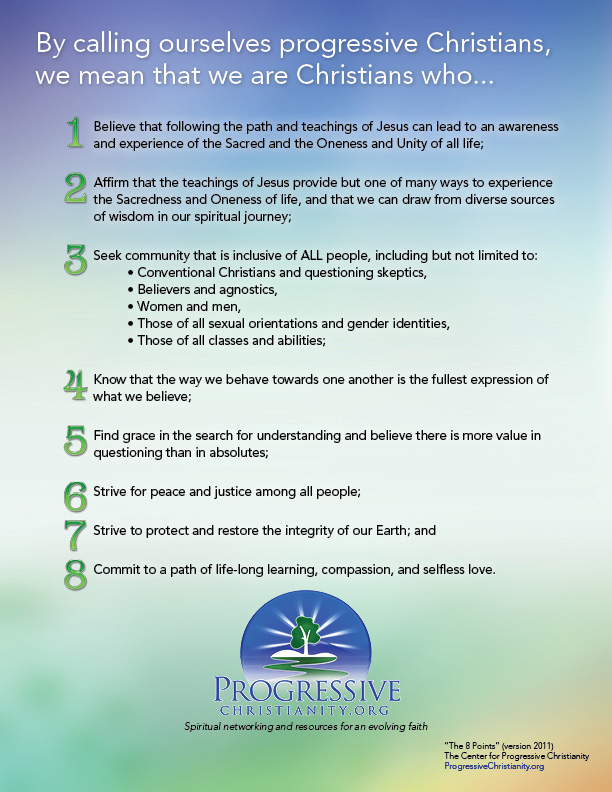
The core question: is this ‘modern’ way of viewing Christianity valid? In other words, is ‘Progressive Christianity’ really Christianity? I hesitate to respond with a resounding “no” simply for the fact that many who identify as ‘Progressive Christians’ do hold to traditional, Biblical views. My reasoned response is this: if you claim to be a Christian, yet your thoughts, ideas, actions, attitudes, etc. differ from, contradict, question, or challenge the teachings of Jesus, you are not a true Christian. To be a Christian means to be a follower of Jesus Christ. If you do not agree with what Jesus declared or affirmed, if you deny the record of Scripture (given to the Biblical writers through the Holy Spirit), then you are not really a follower of Jesus and you should pick a new name to identify yourself.
In recent weeks I taught on some of the basic ideas of ‘Progressive Christianity,’ contrasting them with traditional teachings of Christianity. I used a 3-part blog series Alisa Childers wrote a few years ago. When it comes to the areas of Creation, the Fall, Redemption, & Restoration, Progressive Christians have a much different ‘gospel’ to tell. This has further prompted me to go through a doctrine series with my class, looking at foundational teachings of Christianity to reinforce what we believe and to guard against questionable teachings which have become more and more widespread throughout churches in America.
An individual’s movement towards ‘Progressive Christianity’ begins with a time of deconstruction, where doubts and questions towards traditionally held beliefs are entertained. As their beliefs are put through the ringer, many things tend to fall by the wayside as they are paired to current cultural issues such as LGBTQ+, immigration, social justice, critical theory, and the like. Also in question is the historical Jesus, did He really say and teach what we find in the red letters of the New Testament OR were those added in by writers with an agenda? After deconstruction has run its course, a time of reconstruction may take place, so long as the individual feels there is a reason to reestablish their faith; a frequent occurrence at the end of deconstruction is for a person to embrace agnosticism or atheism. In the end, if the person does reconstruct his / her faith, 99% of the time they come up with a Jesus different from the One declared in the Bible; they have created a personal ‘Jesus’ to follow—in essence, an idol.
I cannot say for sure that this is what occurred in the life of my former mentor. I did not know enough about ‘Progressive Christianity’ at the time to ask if this is how he would identify his beliefs. From what I surmise during our last discussion on social media several years ago, I believe he would absolutely declare himself as a ‘Progressive Christian.’ Given the opportunity to question him further, I would ask him to describe the Jesus he follows and the Scripture he holds as sacred and true. I doubt very much that his answer would reflect the Jesus I know from the Bible; I’m quite certain he has created his own Jesus to follow, one who would not do or say the things the Bible records regarding Jesus of Nazareth.
Some of these differences are subtle. Some of them are glaringly different and contradictory. The danger lies in the deviation from what the Bible affirms. If we, as Christians, question the very truth of Scripture, we are in a dangerous place. That is not to condemn doubts and questions; those can be good and drive us to seek answers. There is much in the Bible I do not understand and may never come to fully understand this side of eternity. That does not cause me to recreate my understanding of God and His story, rather it pushes me to find answers I am reasonably satisfied with and in my almost 27 years as a Christian, I still hold to the truth of the Bible and the teachings of Jesus contained therein. I don’t always get things right and I fall short many times. Regardless, though, when something in life conflicts with the Bible, I choose the Bible!
~In Christ!
[1] ProgressiveChristianity.org
[2] What is Progressive Christianity, and is it biblical? | GotQuestions.org
 Way Truth Life Apologetics
Leave a comment