

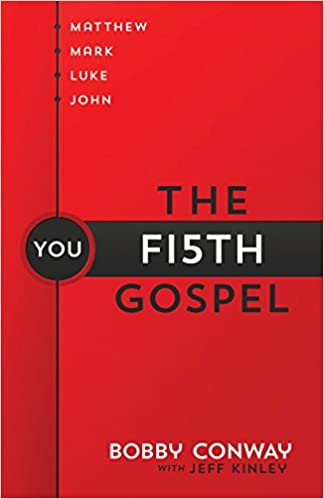
One of my goals this year is to read more; my aim is to read at least one book per month. I finished up Cold Case Christianity by J Warner Wallace for January with a couple days to spare. For February I’m working on The Fi5th Gospel by Bobby Conway, a.k.a. the One Minute Apologist. The premise of the book comes from a statement from Gypsy Smith which is quoted in the introduction, “There are five Gospels: Matthew, Mark, Luke, John, and the Christian, but most people never read the first four.[1]” I invite you to take a moment to reflect on that claim; it is quite profound. Once you declare yourself a Christian, there are eyes constantly watching you, how you talk, how you act, and especially how you treat others.
I want to spend some time focusing on a series of questions / statements which are listed in Chapter 1. As I read them, I paused and thought how I would answer each of them. Perhaps you have been challenged in the past and have struggled to come up with an adequate response so I want to give you a starting point (at the very least) should you encounter these in the future.
- “It doesn’t matter what you believe as long as you’re sincere.[2]”
At face value this may seem sensible. However, it is flawed. Sincerity does not determine the truth of something. Muslims are sincere that the Koran is the word of Allah and what is claimed within its writings are 100% true. Likewise, Christians sincerely believe that the Bible is God’s Word, and its claims are 100% true. But there are points of conflict within the pages of these two books, within their differing accounts of the same events. Being sincere in what one believes DOES NOT have bearing whether that belief is true. So, being sincere is not a valid qualifier as it pertains to one’s beliefs.
- “As long as it works for you and makes you happy.[3]”
Does that truly work? Is a person’s happiness the ultimate goal for his / her life? I would wager that Adolf Hitler, Charles Manson, and the KKK were happy with the work they were doing to fulfill their goals. Hitler ran a nation and the persecution, imprisonment, and killing of millions of people worked well for him, in his mind. Manson’s directives to his followers to carry out killings he determined to be necessary worked well for him, in his mind. Like sincerity above, happiness is not a valid qualifier for such matters, especially when what may make one person happy may cause pain, suffering, and / or death for another or many others.
- “There’s no such thing as ultimate (or absolute) truth.[4]”
I’ve come across this claim numerous times over the past 10-15 years, and I know (now) that this statement is contradictory / self-defeating. It is making an absolute truth claim while denying absolute truth exists. This statement fails to meet its own qualifications. As Greg Koukl would say, “it commits suicide.” It is nonsensical.
- “I believe there are many ways to God.[5]”
This is one of the root statements of pluralism. Pluralism claims that there are many different paths a person can take, yet they all lead to the same end. Think of a mountain and God is at the top. Now imagine there are several different paths up the mountain to reach the summit; each path represents a different religious worldview. This idea fails due to the exclusivity of truth claims. Every religious worldview (even atheism) makes claims that are exclusive to its core beliefs. Where these claims contradict the claims of another worldview, they cannot both be right (according to the Law of Non-Contradiction). Both could be false, but both cannot be right. For example, theism claims God exists. Atheism claims God does not exist. God cannot both exist and not exist; both worldviews could be wrong, BUT they cannot both be right.
- “It’s rude to say one person’s religion is better than another’s,[6]”
I agree somewhat, to outright declare to a person that their worldview / religion is wrong can be very poor manners and rude. There are nuanced and civil ways to engage, discuss, and debate the differences regarding someone’s beliefs. The saying “you catch more flies with honey” comes to mind; it’s not necessary to sugar coat everything or to concede points just to be passive and nonconfrontational. Sometimes pushback is justified; there are certain non-negotiables one should be willing to stand for and defend. Time should be taken to understand different worldviews and their teachings in order to assess and weigh the validity and reasonability of each. However, as it pertains to matters of eternity and whether there is a God, as stated above, all religions cannot be right. They differ fundamentally and so one may rise above the others. By definition, that would make one religion / worldview better than the others.
- “It takes everyone’s truth to equal the truth.[7]”
This is also non-sensical. By what standard does truth require a consensus OR the summation of all beliefs? For those who believe the earth is flat, does their “truth” add to the truth of those who believe the earth is a sphere? Do competing ideas add to each other, seek to cancel each other out, OR is one idea found to correspond with reality and in fact be objectively true? My kindergartener believes babies come from mommies and daddies kissing. Is her truth validated by what we understand regarding human reproduction? No, truth is not an aggregate of collected “truths.”
- “What makes you think your religion is right and everyone else is wrong?[8]”
To answer this question, one must be ready to give an answer for his / her beliefs (1 Pet 3:15). It boils down to the nature of truth. Truth is that which corresponds to reality. Given the laws of logic, particularly the Law of Non-Contradiction, if a statement or claim is proven to be true, any statement or claim which contradicts that claim cannot be true. To put this in context, in John 14:6, Jesus makes the claim that He (alone) is the way to God. Islam claims different. Hinduism claims different, Buddhism denies the existence of God (it is non-theistic), and so on. IF Jesus’ statement is true, then He is the only way to God and the reasonable conclusion is that all other worldviews are wrong, if they deny or oppose what Jesus has claimed.
I hope these help you as you engage with family, friends, co-workers, neighbors, or even complete strangers as you go about day to day and have opportunities to share your faith. Christians are not without answers to these and many other questions. The issue for most Christians is they are not confident or knowledgeable enough to respond to challenges like these. Peter commanded us to be read to give a defense or reason for the hope that is within us (1 Pet 3:15). It’s not just for pastors or trained theologians; Peter was addressing Christians. We are all called to be able to respond and answer questions regarding our faith. That is my aim with his post and this blog in general.
~In Christ!
[1] Conway, B. (2014). The Fi5th Gospel (p, 9), Eugene, OR: Harvest House Publishers.
[2] Conway, B. (2014). The Fi5th Gospel (p. 21). Eugene, OR: Harvest House Publishers.
[3] Conway, B. (2014). The Fi5th Gospel (p. 21). Eugene, OR: Harvest House Publishers.
[4] Conway, B. (2014). The Fi5th Gospel (p. 21). Eugene, OR: Harvest House Publishers.
[5] Conway, B. (2014). The Fi5th Gospel (p. 21). Eugene, OR: Harvest House Publishers.
[6] Conway, B. (2014). The Fi5th Gospel (p. 21). Eugene, OR: Harvest House Publishers.
[7] Conway, B. (2014). The Fi5th Gospel (p. 21). Eugene, OR: Harvest House Publishers.
[8] Conway, B. (2014). The Fi5th Gospel (p. 21). Eugene, OR: Harvest House Publishers.
 Way Truth Life Apologetics
Leave a comment