

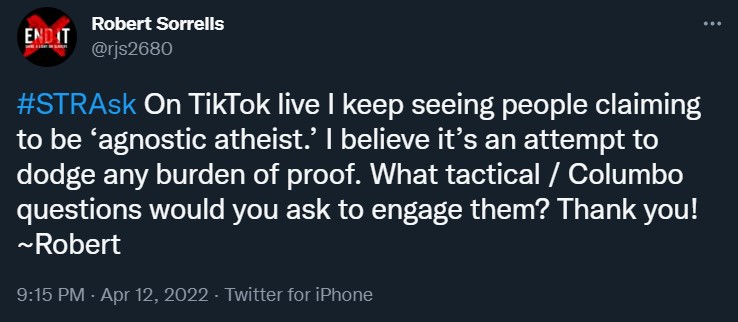
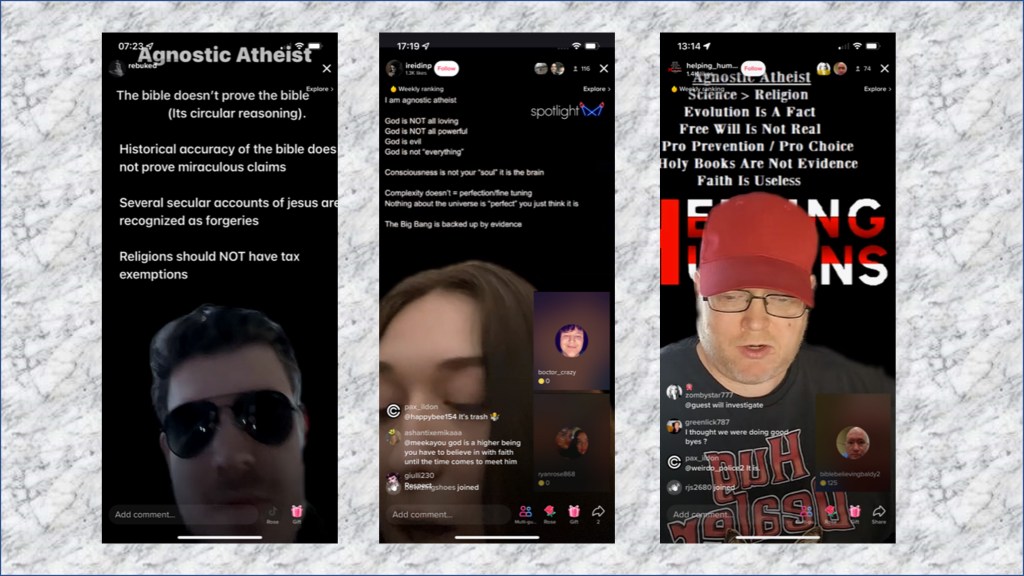
I was a latecomer to the social media platform, TikTok. That did not stop me from seeing an opportunity to engage people I would likely never meet in person and present the truth of Christianity to them. In recent months, however, I noticed a common trend with some of the live broadcasters; the background has at the top “Agnostic Atheist.” I spent a fair amount of time gathering screen shots and listening to some of the discussion, figuring out how I would engage their title and claims. As I became fairly confident in how I wanted to pushback, I sent a tweet to #STRAsk, a podcast of Stand To Reason. Several weeks ago, Amy and Greg shared and engaged my question (I’m still tickled about that). Their responses to the idea were about 99% what I had come up with and I know that is the result of about 15 years of me engaging with apologetics and learning from wonderful Christian apologists such as those at STR.
So, the question for you, the reader, is how would you engage someone claiming to be an ‘agnostic atheist’?
My approach begins with getting clarity of the terms. What does the person mean by “agnostic” and “atheist”? These words have established definitions and if the individual is changing those definitions, that further adds to the confusion. Let us begin with the traditional, academic meaning to those two words. Agnostic comes from the Greek gnosis (knowledge) with the negation (a). Oxford Dictionaries defines ‘agnostic’ as, “a person who believes that nothing is known or can be known of the existence or nature of God or of anything beyond material phenomena; a person who claims neither faith nor disbelief in God.” Simply put, nothing can be known with certainty; the idea is epistemic (dealing in the realm of knowledge). Agnosticism does not extend only to theological ideas, but for our purposes in how it is being used, ‘agnostic’ is directed towards knowledge (or lack thereof) pertaining to God.
Our second term, ‘atheist,’ is defined by Merriam-Webster as, “a person who does not believe in the existence of a god or any gods : one who subscribes to or advocates atheism.[1]” ‘Atheist’ also derives from the Greek; ‘theos’—God, and the negation (a) meaning “no God.” I intentionally used a different online dictionary and here is why: in recent years, perhaps most popularly with Richard Dawkins, the term ‘atheist’ has been redefined as, “a person who disbelieves or lacks belief in the existence of God or gods.” (Oxford Dictionary). This concept of lacking a belief deviates from the classical definition of atheist. The claim of one to ‘lack a belief’ is mostly used to remove any burden of proof. The issue is, though one may claim to ‘lack a belief,’ they do in fact have beliefs about things and still maintain a burden of proof to justify those beliefs; it’s merely an intellectual dodge.
As Greg addressed in the podcast episode, there are three logical responses to the statement, “God exists:” affirm / agree (yes), disagree / deny (no), or ‘I don’t know.” Agreeing with the statement is the theist position, disagreeing is the atheist position, and ‘I don’t know’ is the agnostic position. Greg also pointed out that theism and atheism pertain to beliefs; agnosticism pertains to knowledge. Essentially, to combine the two notions of ‘agnostic atheist’ is a disservice to discussion / debate; a manipulative / deceptive attempt to remove any burden of proof on their part.
Understanding these two terms and how they are likely being misused will hopefully open the other person up to honest dialogue. My immediate thought upon seeing this title is that the individual is trying to not have to defend their position / claims. However, that is not how debate / discussion works. When someone makes a claim, they have an onus to defend their claim with reason and evidence. The same would apply with an attempt to redefine these two words from their classical definitions and understanding. “Why are you redefining these terms?” is a valid inquiry.
My next question would be, “what do you believe pertaining to reality (origin of life, purpose & meaning, morality, supernatural / spiritual matters, etc). These areas of thought are still fair game as all people have either theistic, atheistic, or agnostic responses to further questions within each category. Ultimately, what we believe about a topic / idea, we need to be able to support reasonably and evidentially, and it all needs to be rooted in reality. I can believe something that does not correspond to reality; that shows my belief to be invalid. I can still believe it if I choose to, but the reality is, my belief has no foundation.
My reason for this post, and asking the question of STR, is to give you, the reader, a resource to engage these types of ideas. When I first saw the claim ‘agnostic atheist’ I knew it was somewhat nonsensical, and likely stemmed from intellectual laziness on the part of some claiming that title. Had I come across the idea 10 or 20 years ago, it would not have sat right with me, but I would have been timid to question or pushback against it. As a Christian, I stand upon the idea of objective truth, and that truth is knowable; especially truth as it pertains to God and what He has revealed in the Bible.
In the coming months, as I continue to come across this concept on social media and engage those holding to the idea, I may write another blog post highlighting those engagements and dialogue. For now, be assured that it’s safe and effective to ask questions when challenged with ideas like this. The idea confused me because I know the definitions of those words and their classical use. That is why I sought confirmation regarding my thoughts on the matter and reached out to a reliable source. Please don’t hesitate to do the same when you come across similar challenges. In the “links” section of this blog I list numerous resources that can be useful as you engage the culture and stand upon the truth of Christianity.
~In Christ!
 Way Truth Life Apologetics
Leave a comment